
What Is Injection Molding and How Does It Work?
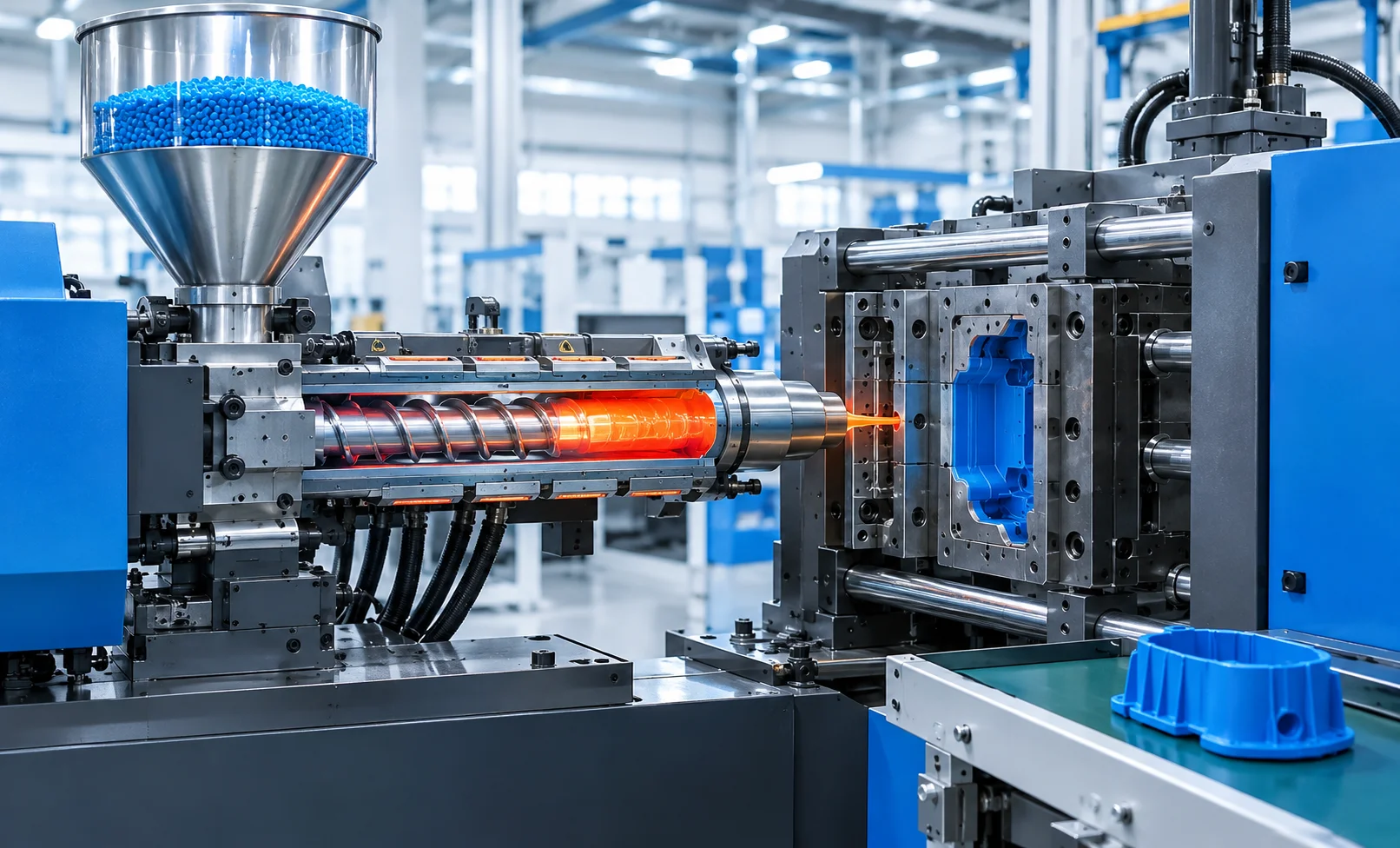
Injection molding is a highly efficient manufacturing technique used to create plastic products and components with accuracy and repeatability. The process is particularly valuable for mass production because manufacturers can produce large numbers of identical parts within a relatively short period.
Today, injection molding is used in a wide variety of sectors, including automotive, electronics, medical equipment, consumer products, packaging, and industrial manufacturing. Its ability to produce detailed shapes while maintaining consistent dimensions makes it a preferred choice for many plastic products.
What Is Injection Molding?
Injection molding is a process in which plastic material is heated until it becomes fluid and is then forced into a mold under controlled pressure. The mold contains a cavity designed according to the shape and dimensions of the required product.
After the material enters the cavity, it is allowed to cool and solidify. The mold then opens, and the completed component is removed. Because the mold can be used repeatedly, the process is well suited to applications requiring high quantities of consistent parts.
How Does Injection Molding Work?
Although injection molding machines can vary in size and design, the basic manufacturing cycle follows a series of steps.
1. Loading the Plastic Material
The process begins with plastic pellets or resin being placed into the machine hopper. The pellets are gradually transferred toward the heating section by a rotating screw.
2. Heating and Plasticizing
As the material moves through the heated barrel, a combination of heat and mechanical movement melts and mixes the plastic. The goal is to achieve a uniform molten material that can flow properly into the mold.
3. Filling the Mold
The screw moves forward and forces the molten plastic through a nozzle into the mold cavity. Injection pressure must be carefully controlled to ensure that the cavity is completely filled and the desired part geometry is achieved.
4. Holding and Cooling
Once the cavity is filled, additional pressure may be applied to compensate for material shrinkage. The component then remains inside the mold while heat is transferred away and the plastic becomes solid.
5. Removing the Part
When the part has cooled sufficiently, the mold separates. Ejector pins or another ejection mechanism then release the molded component from the cavity.
6. Quality Checking and Post-Processing
Depending on the product, additional operations may be necessary. These can include removing runners or flash, surface treatment, assembly, dimensional inspection, and other quality-control procedures.
Common Materials for Injection Molding
One of the major strengths of injection molding is its compatibility with many different plastic materials. The material chosen for a particular product depends on its intended use and required performance characteristics.
Frequently used materials include:
- ABS: Commonly selected for its toughness, appearance, and impact resistance.
- Polypropylene (PP): Lightweight and resistant to many chemicals and moisture.
- Polyethylene (PE): Available in different grades and widely used for packaging and consumer products.
- Polycarbonate (PC): Known for strength, transparency, and impact resistance.
- Nylon (PA): Suitable for applications requiring mechanical strength and wear resistance.
- Polystyrene (PS): Often used where rigidity and economical production are important.
- POM: Provides good dimensional stability and low friction for precision components.
- PEEK: A high-performance engineering plastic used in demanding environments.
Key Benefits of Injection Molding
High-Volume Manufacturing
Once the mold and production parameters are established, the manufacturing cycle can be repeated rapidly. This makes the process suitable for producing large quantities of components.
Excellent Repeatability
Modern injection molding equipment can maintain consistent processing conditions, helping manufacturers produce parts with uniform dimensions and quality.
Complex Product Designs
Molds can incorporate detailed features such as ribs, bosses, openings, textures, and other geometric elements, allowing manufacturers to create sophisticated components.
Reduced Production Costs
Although designing and manufacturing a mold can involve substantial upfront expenditure, the cost per component can become economical when production volumes are high.
Efficient Material Usage
With appropriate mold and process design, material consumption can be controlled and production waste can be reduced.
Flexible Product Options
Manufacturers can select from numerous plastic grades, colors, finishes, and material formulations to achieve the required properties and appearance.
Where Is Injection Molding Used?
Injection molding has applications across almost every major manufacturing sector.
Automotive Industry
It is used to manufacture items such as interior components, covers, brackets, housings, clips, and other plastic parts.
Electronics
Electronic products often contain injection-molded enclosures, connectors, switches, protective covers, and structural components.
Medical Products
The process can be used to manufacture a variety of medical and laboratory components where precision, cleanliness, and material performance are important.
Packaging
Caps, closures, containers, and other packaging components are commonly produced using injection molding.
Consumer Products
Many everyday products, including household items, toys, storage products, and appliance components, are manufactured using this technique.
Industrial Components
Injection molding is also used for gears, housings, fittings, protective components, and other engineered plastic parts.
Factors That Influence Injection Molding Quality
Producing a high-quality molded component involves more than simply injecting plastic into a mold. Several factors must be considered, including:
- Mold design and construction
- Plastic material and grade
- Injection pressure and speed
- Melt temperature
- Mold temperature
- Cooling time
- Part design and wall thickness
- Shrinkage and warpage
- Machine settings and maintenance
Proper control of these parameters helps reduce defects and improves dimensional consistency.
Injection Molding and Modern Manufacturing
Injection molding is a versatile and reliable method for plastic manufacturing components in high quantities. Its combination of speed, repeatability, design flexibility, and material options makes it suitable for applications ranging from everyday consumer products to demanding industrial and automotive components.
A successful injection molding project depends on several elements, including appropriate material selection, effective mold design, accurate machine settings, controlled cooling, and consistent quality inspection. When these factors are properly managed, injection molding can provide an efficient solution for producing durable and precise plastic products.
How Does Injection Molding Work?
The injection molding process involves heating plastic material, injecting it into a specially designed mold, and cooling it to create a finished plastic part. The process consists of several controlled steps to achieve accurate dimensions, consistent quality, and repeatable production.
1. Mold Preparation
The process begins with designing and preparing the mold according to the required shape and specifications of the plastic component. The mold is installed and securely clamped into the injection molding machine.
Example: For a plastic enclosure, the mold includes the required cavities, screw holes, mounting points, and other design features.
2. Material Feeding
Plastic pellets are selected based on the required properties of the final product and loaded into the machine’s hopper. The pellets are then transferred into the heated barrel.
Common materials: ABS, Polypropylene (PP), Polycarbonate (PC), Nylon, POM, and PE.
3. Plastic Melting
The plastic pellets move through a heated barrel, where heat and mechanical action from the rotating screw melt the material into a uniform molten state.
Example: ABS pellets are heated until they become soft and flowable enough to be injected into the mold.
4. Plastic Injection
The molten plastic is injected into the mold cavity under controlled pressure and speed. The material flows through the mold’s runner and gate system until the cavity is completely filled.
Example: Molten plastic fills the entire cavity and takes the exact shape of the required component.
5. Packing and Holding
After the mold cavity is filled, additional pressure is applied to compensate for material shrinkage during cooling. This helps maintain the required part dimensions and reduces defects.
6. Cooling
The plastic part is allowed to cool and solidify inside the mold. Cooling channels within the mold help control the temperature and improve cycle consistency.
Example: A plastic housing remains in the mold until it becomes rigid enough to be safely removed.
7. Mold Opening
Once the component has sufficiently cooled, the machine opens the mold. The two mold halves separate to expose the finished part.
8. Part Ejection
Ejector pins or other ejection mechanisms push the solidified plastic component out of the mold.
Example: The completed plastic enclosure is automatically released from the mold and transferred for further processing.
Conclusion
Injection molding is a versatile and reliable method for manufacturing plastic components in high quantities. Its combination of speed, repeatability, design flexibility, and material options makes it suitable for applications ranging from everyday consumer products to demanding industrial and automotive components.
A successful injection molding project depends on several elements, including appropriate material selection, effective mold design, accurate machine settings, controlled cooling, and consistent quality inspection. When these factors are properly managed, injection molding can provide an efficient solution for producing durable and precise plastic products.