
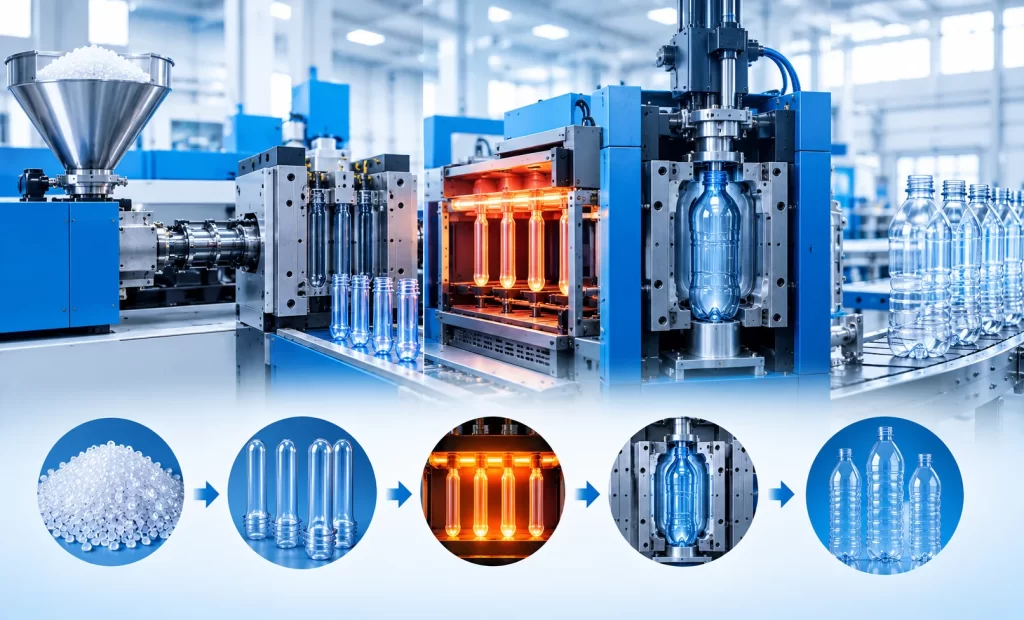
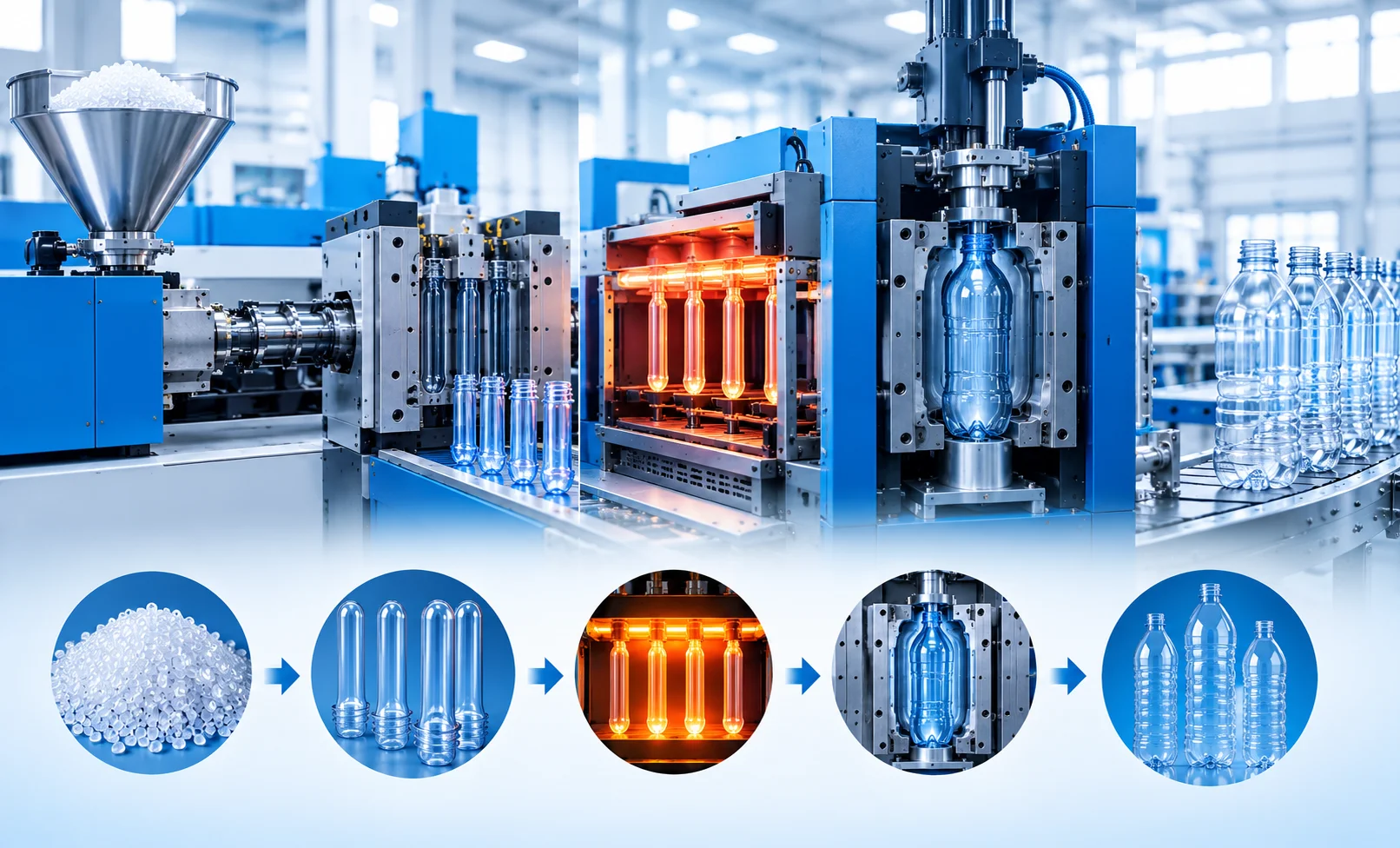
Plastic bottles are used every day for beverages, personal care products, household cleaners, medicines, and many other products. But how plastic bottles are manufactured depends on the bottle design, material, size, and production volume. In most cases, manufacturers use injection molding to create a bottle preform and then use blow molding to form the final bottle shape. This combination allows manufacturers to produce lightweight, strong, and consistent bottles at high production speeds. Understanding the process helps product companies choose the right material, equipment, mold design, and manufacturing method for their needs.
What Is Plastic Bottle Manufacturing?
Plastic bottle manufacturing is the process of converting plastic resin into finished bottles with a specific shape, size, thickness, and appearance.
Common materials include PET, HDPE, PP, and LDPE. Among these, PET is widely used for beverage bottles because it is lightweight, transparent, and suitable for many packaging applications.
The manufacturing process generally involves:
- Plastic resin preparation
- Melting and molding
- Preform production
- Blow molding
- Cooling
- Trimming and finishing
- Quality inspection
The exact process can vary depending on the type of bottle and plastic material being used.
How Plastic Bottles Are Made Step by Step
1. Plastic Material Preparation
The process starts with plastic resin supplied in small pellets. The selected material is dried or prepared according to its properties and production requirements.
For example, PET requires controlled drying because moisture can affect the quality and strength of the finished bottle.
2. Injection Molding of the Preform
For many PET bottles, injection molding is used to produce a small tube-like component called a preform.
The plastic pellets are heated until they become molten. The molten plastic is then injected into a precision mold under controlled pressure.
Once cooled, the preform has the bottle neck and thread already formed. It is then ready for the next manufacturing stage.
3. Preform Heating
Before blow molding, the preform is reheated to make the plastic soft and stretchable.
Heating must be carefully controlled because uneven temperature distribution can result in inconsistent bottle walls or poor dimensional accuracy.
4. Blow Molding
The heated preform is placed inside a bottle-shaped mold. Compressed air is introduced into the preform, causing the softened plastic to expand against the inside walls of the mold.
The plastic takes the exact shape of the mold cavity.
This is the key stage that transforms the small preform into the final bottle.
5. Cooling and Ejection
After the bottle reaches its required shape, the mold helps cool the plastic. Once sufficiently stable, the finished bottle is removed from the mold.
Cooling time affects cycle time, dimensional stability, and production efficiency.
6. Inspection and Finishing
Finished bottles are inspected for defects such as:
- Uneven wall thickness
- Deformation
- Cracks
- Flash
- Poor neck dimensions
- Surface defects
- Leakage
Bottles that meet the required specifications are moved to packaging or filling operations.
What Is a Plastic Bottle Manufacturing Machine?
A plastic bottle manufacturing machine is production equipment designed to form plastic bottles from resin or preforms.
Depending on the process, equipment can include injection molding machines, preform molds, reheating systems, blow molding machines, air compressors, cooling systems, and inspection equipment.
Modern production lines can combine several automated operations to improve consistency and reduce manual handling.
Injection Molding vs. Blow Molding
Injection molding and blow molding are two key processes used in bottle manufacturing. Although they are part of the same production cycle, each process has a different role.
|
Process |
Purpose |
|
Injection Molding |
Produces the bottle preform with accurate dimensions and consistent quality. |
|
Blow Molding |
Expands and shapes the preform into the final bottle or container. |
|
Cooling |
Cools the molded bottle and helps maintain its final shape and dimensions. |
|
Inspection |
Checks the finished bottle for defects, dimensions, appearance, and overall quality. |
In simple terms, injection molding creates the preform, while blow molding turns the preform into the finished bottle.
For PET beverage bottles, Injection Stretch Blow Molding (ISBM) is commonly used. The PET preform is heated and stretched lengthwise while compressed air expands it outward against the mold, creating the final bottle shape with the required size and design.
Key Benefits of Plastic Bottle Manufacturing
Modern molding processes offer several advantages for packaging manufacturers:
- High production speed: Large quantities can be produced within short production cycles.
- Consistent quality: Automated machines provide repeatable dimensions and shapes.
- Lightweight products: Plastic bottles can be designed to use less material while maintaining performance.
- Design flexibility: Manufacturers can create different shapes, neck sizes, colors, and surface designs.
- Material efficiency: Bottle designs can be optimized to reduce unnecessary material usage.
- Scalability: Production can be increased as product demand grows.
- Cost efficiency: High-volume production can reduce the manufacturing cost per bottle.
Key Benefits of Plastic Bottle Manufacturing
Different plastics are selected according to the bottle’s intended application.
PET
PET is commonly used for water, soft drink, juice, and other beverage bottles. It offers transparency, strength, and good dimensional stability.
HDPE
HDPE is durable and commonly used for milk containers, detergent bottles, shampoo bottles, and chemical packaging.
PP
Polypropylene provides good chemical resistance and heat performance. It is used for certain food, pharmaceutical, and household packaging products.
LDPE
LDPE is flexible and is often used for squeeze bottles and packaging that needs easy deformation.
Applications of Plastic Bottle Manufacturing
Although the process is highly automated, manufacturers still need to control several factors.
Uneven Wall Thickness
Incorrect heating, stretching, or process settings can cause uneven material distribution. Proper preform design and temperature control can help address this issue.
Bottle Deformation
Insufficient cooling or incorrect processing conditions may affect the final bottle shape. Mold cooling and process parameters need to be carefully controlled.
Material Waste
Poor mold design or incorrect process settings can increase material consumption. Lightweighting and optimized mold design can help reduce waste.
Quality Variation
Changes in material, temperature, pressure, or cycle time can affect bottle quality. Automated monitoring and regular inspection help maintain consistency.
What Is a Fully Automatic Plastic Bottle Making Machine?
A fully automatic plastic bottle making machine can automate major production operations, including preform handling, heating, bottle forming, cooling, and product discharge.
Automation can reduce manual handling and help manufacturers achieve consistent production cycles, especially when producing large volumes.
Common Challenges in Bottle Manufacturing
Although the process is highly automated, manufacturers still need to control several factors.
Uneven Wall Thickness
Incorrect heating, stretching, or process settings can cause uneven material distribution. Proper preform design and temperature control can help address this issue.
Bottle Deformation
Insufficient cooling or incorrect processing conditions may affect the final bottle shape. Mold cooling and process parameters need to be carefully controlled.
Material Waste
Poor mold design or incorrect process settings can increase material consumption. Lightweighting and optimized mold design can help reduce waste.
Quality Variation
Changes in material, temperature, pressure, or cycle time can affect bottle quality. Automated monitoring and regular inspection help maintain consistency.
Future Trends in Plastic Bottle Manufacturing
Plastic bottle production is moving toward greater automation, material efficiency, and sustainable manufacturing.
Manufacturers are exploring lightweight bottle designs, increased use of recycled materials, energy-efficient molding equipment, and smarter production monitoring.
Digital manufacturing technologies can also help companies monitor production data, identify process variations, and improve overall equipment performance.
Another important trend is the development of bottle designs that use less material without compromising the required strength and functionality.
Conclusion
Plastic bottle production combines material preparation, injection molding, preform manufacturing, heating, blow molding, cooling, and quality inspection. Injection molding provides the precise preform, while blow molding transforms it into the final bottle shape. With the right material, mold design, equipment, and process controls, manufacturers can produce bottles that are consistent, lightweight, durable, and suitable for different applications.
FAQS
How many plastic bottles make 1 kg?
The number depends on the bottle’s size and weight. For example, a 20-gram bottle would require approximately 50 bottles to equal 1 kg of plastic, excluding caps and other components.
How much does it cost to manufacture a plastic bottle?
The number depends on the bottle’s size and weight. For example, a 20-gram bottle would require approximately 50 bottles to equal 1 kg of plastic, excluding caps and other components.
How much does it cost to manufacture a plastic bottle?
The cost depends on bottle size, material, mold cost, production volume, labor, energy, and finishing requirements. High-volume production generally lowers the cost per bottle.
How much does it cost to manufacture a plastic bottle?
The seven commonly recognized resin identification categories are PET, HDPE, PVC, LDPE, PP, PS, and Other. The “Other” category includes plastics that do not fit the first six groups.
Which plastic is stronger than steel?
No common plastic is universally stronger than steel. Some advanced engineering plastics and fiber-reinforced composites can have very high strength-to-weight ratios and may outperform certain metals in specific applications.